Full TCO Analysis Report
Complete 3-year Total Cost of Ownership comparison — on-premises or current cloud vs target cloud. Covers AWS, Azure, GCP, OCI and Alibaba Cloud with real 2026 pricing.
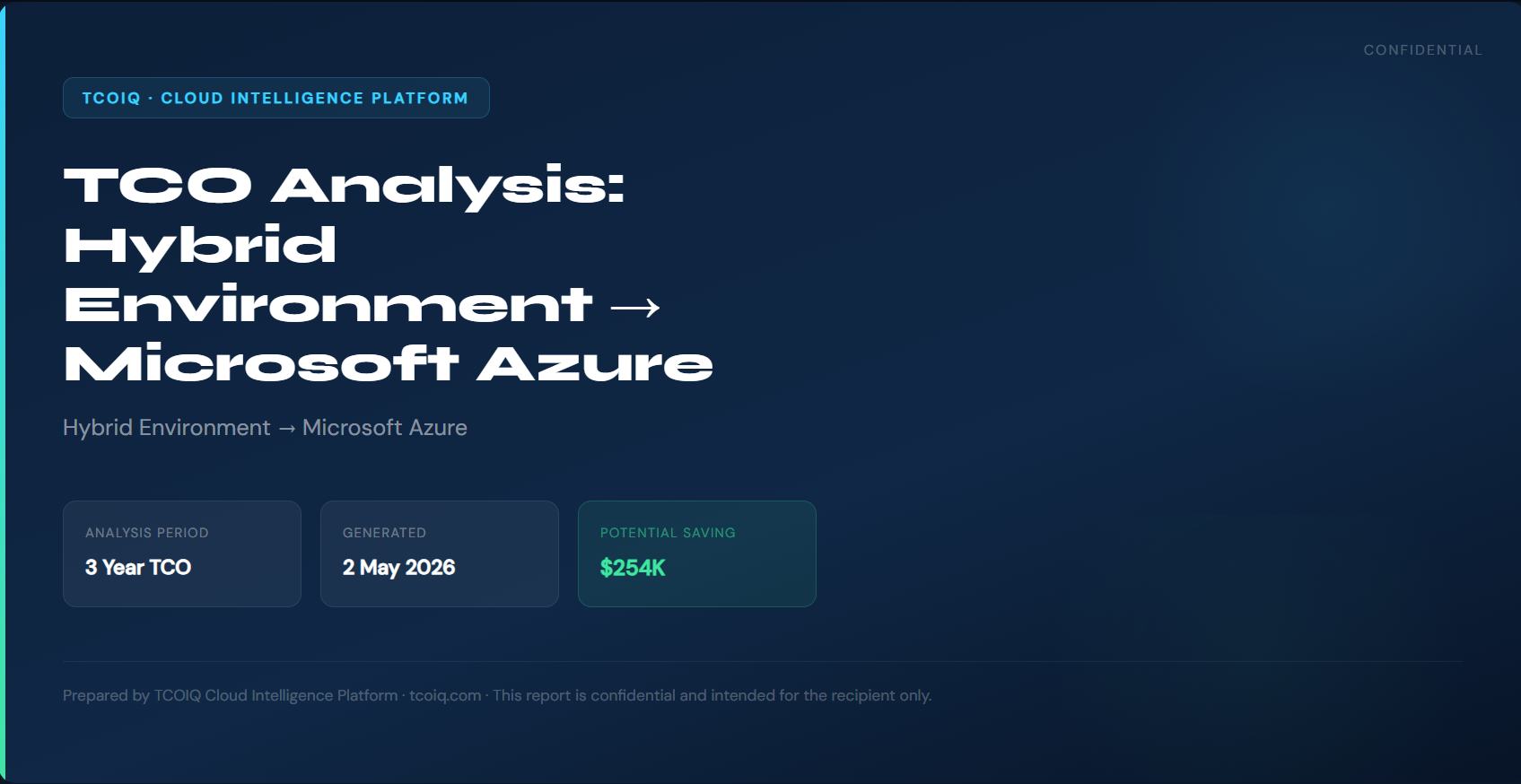
Report Cover Page — Cloud migration TCO analysis: Hybrid Environment (50 DC + 11 cloud servers) → Microsoft Azure. Shows 3-year analysis period, potential saving and confidentiality notice.
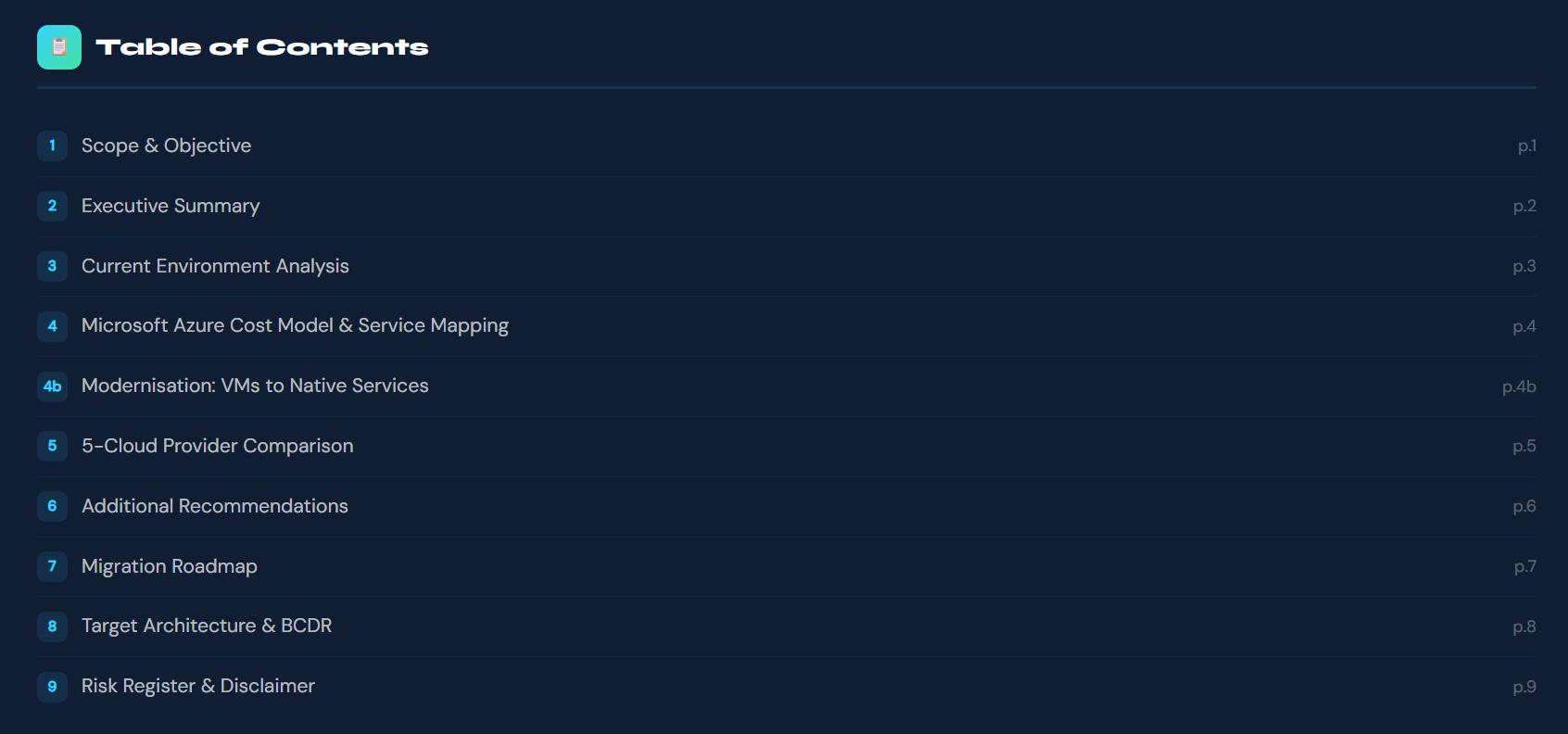
Table of Contents — 9-section report: Scope & Objective, Executive Summary, Current Environment Analysis, Target Cloud Cost Model, 5-Cloud Comparison, Additional Recommendations, Migration Roadmap, Target Architecture & BCDR, Risk Register.
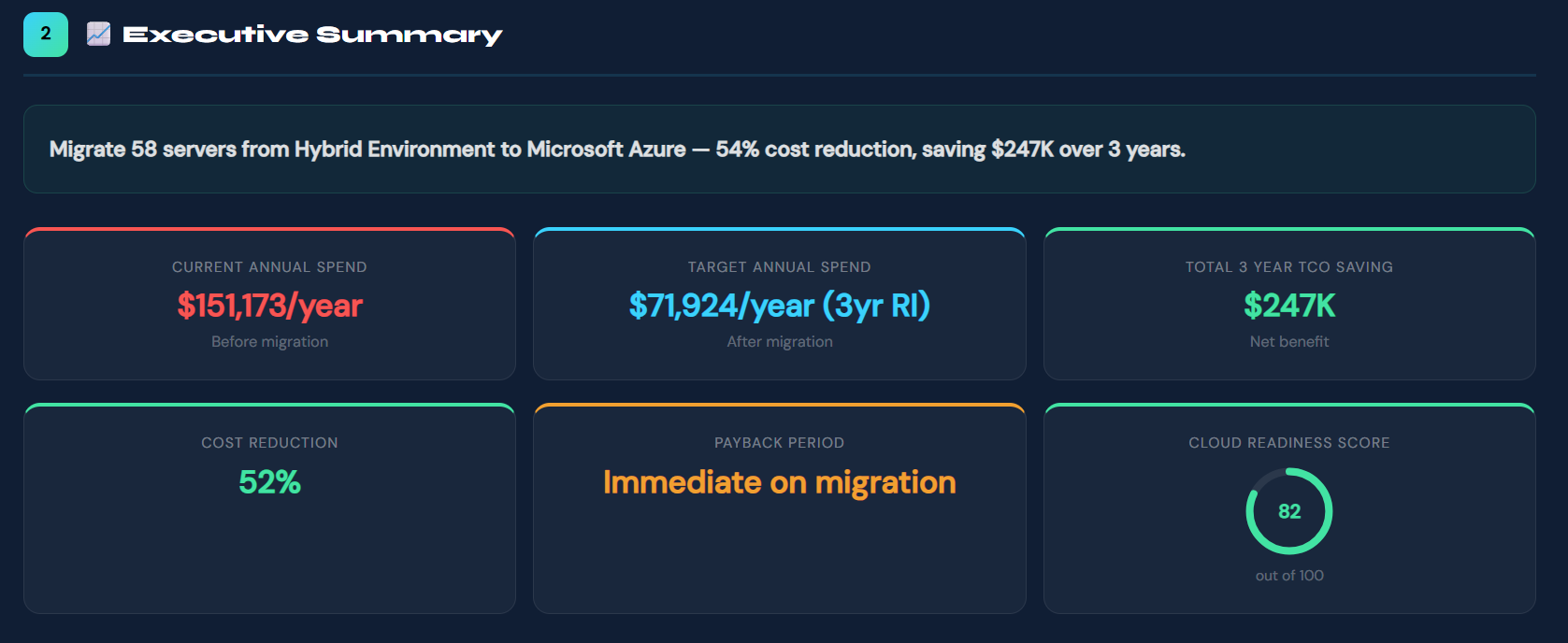
Executive Summary — Current annual spend vs target cloud spend, 3-year TCO saving, cost reduction percentage, cloud readiness score and top P1/P2/P3 recommendations.
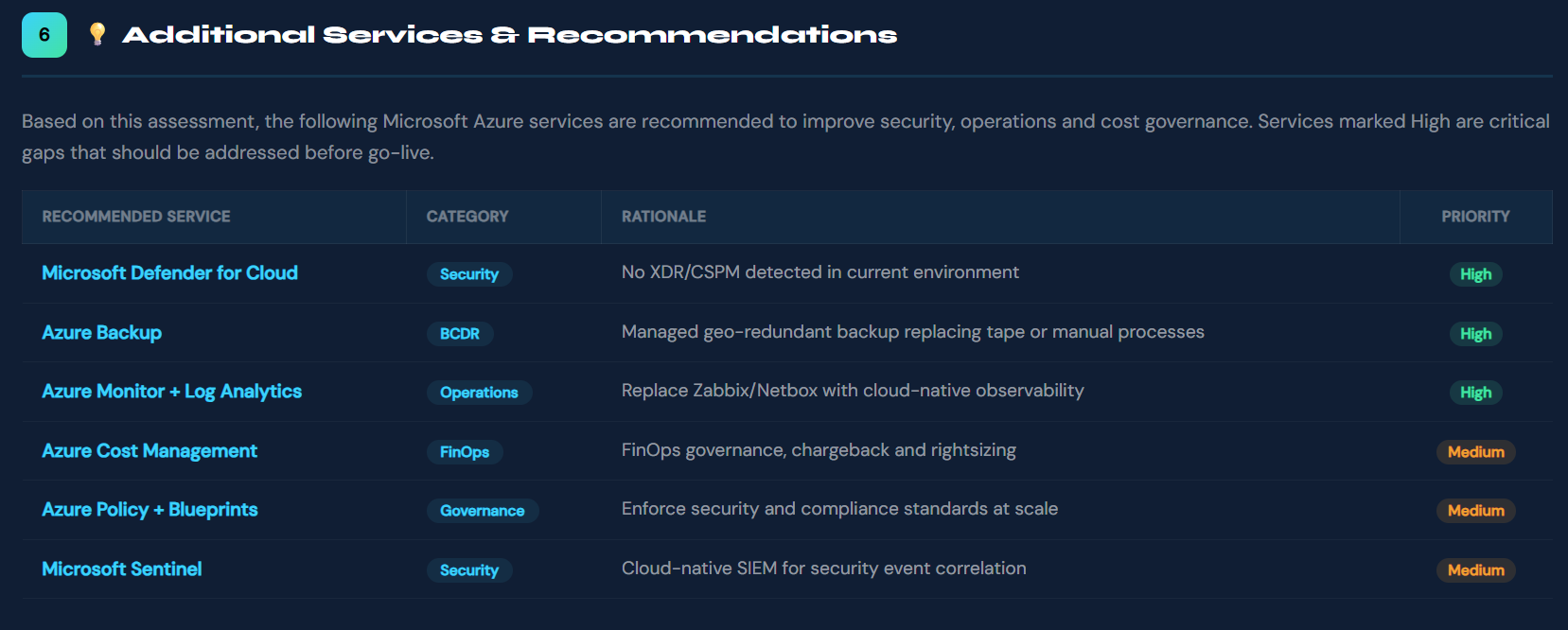
Additional Services & Recommendations — Native cloud service replacements (Zabbix → Azure Monitor, SAP workloads, database PaaS migration) with cost impact and effort rating.
💰
3-Year Cost Model
On-demand, 1-year and 3-year Reserved Instance pricing for every server
☁️
5-Cloud Comparison
AWS, Azure, GCP, OCI and Alibaba Cloud — side by side with real 2026 pricing
📋
Migration Roadmap
Wave-by-wave migration plan with timelines, effort and risk ratings
🏗️
Target Architecture
Cloud-native service mapping and BCDR design for your target cloud
What is Cloud TCO Analysis?
A cloud Total Cost of Ownership (TCO) analysis compares the full cost of running workloads on-premises versus in the cloud — or between cloud providers. It goes beyond compute pricing to include storage, networking, licensing, migration costs, staffing savings and operational overhead.
TCOIQ's AI-powered TCO engine analyses your server inventory or cloud billing export and produces a detailed 3-year cost model across AWS, Azure, GCP, OCI and Alibaba Cloud — including Reserved Instance discounts (up to 50% savings), Azure Hybrid Benefit and native service replacements.
Common findings: organisations migrating from on-premises to cloud typically save 30-55% on infrastructure costs over 3 years. The biggest savings come from eliminating hardware refresh cycles, right-sizing compute to actual workloads, and replacing expensive monitoring and middleware with native cloud services.
Common TCO Analysis Use Cases
On-premises → Azure TCO
On-premises → AWS TCO
On-premises → GCP TCO
On-premises → OCI TCO
AWS → Azure migration TCO
Azure → AWS TCO comparison
Hybrid cloud → single cloud TCO
Data centre exit TCO
VMware → cloud TCO
SAP cloud migration TCO
Cloud vs on-premises cost
Multi-cloud cost comparison
Migration Readiness Assessment
AI-powered readiness scoring for cloud migration. Identifies blockers, assigns servers to migration waves, assesses skills gaps and maps dependencies — before you start migrating.
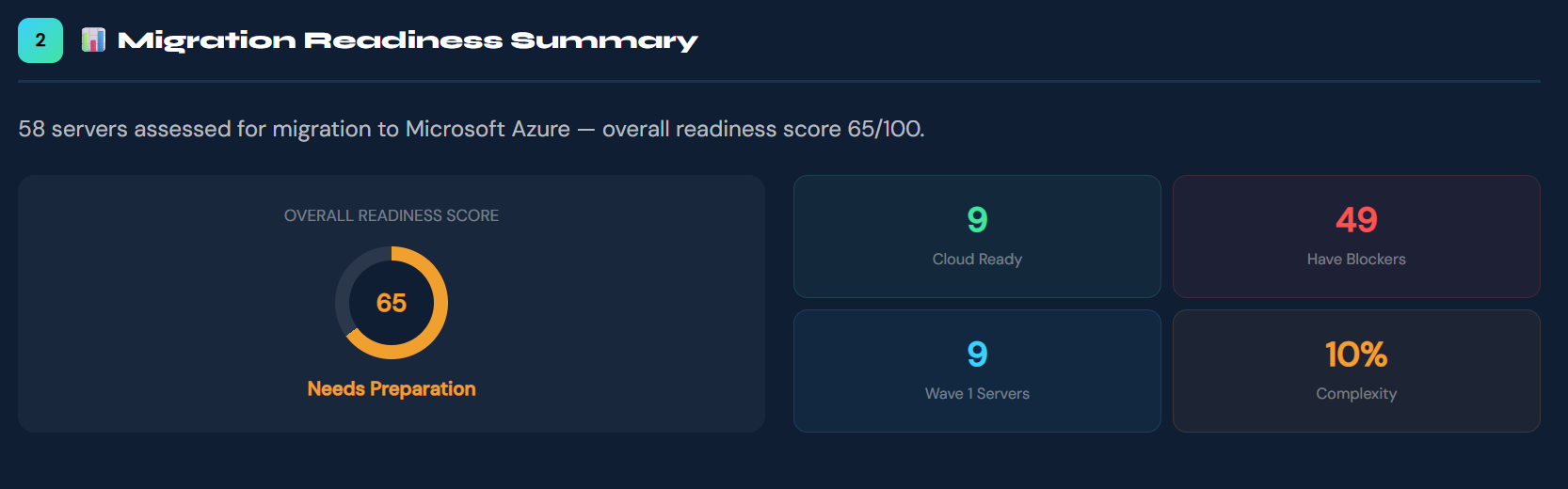
Migration Readiness Summary — Overall readiness score (0-100), cloud-ready server count, servers with blockers, wave 1 count and complexity score. Each server gets an individual readiness rating.
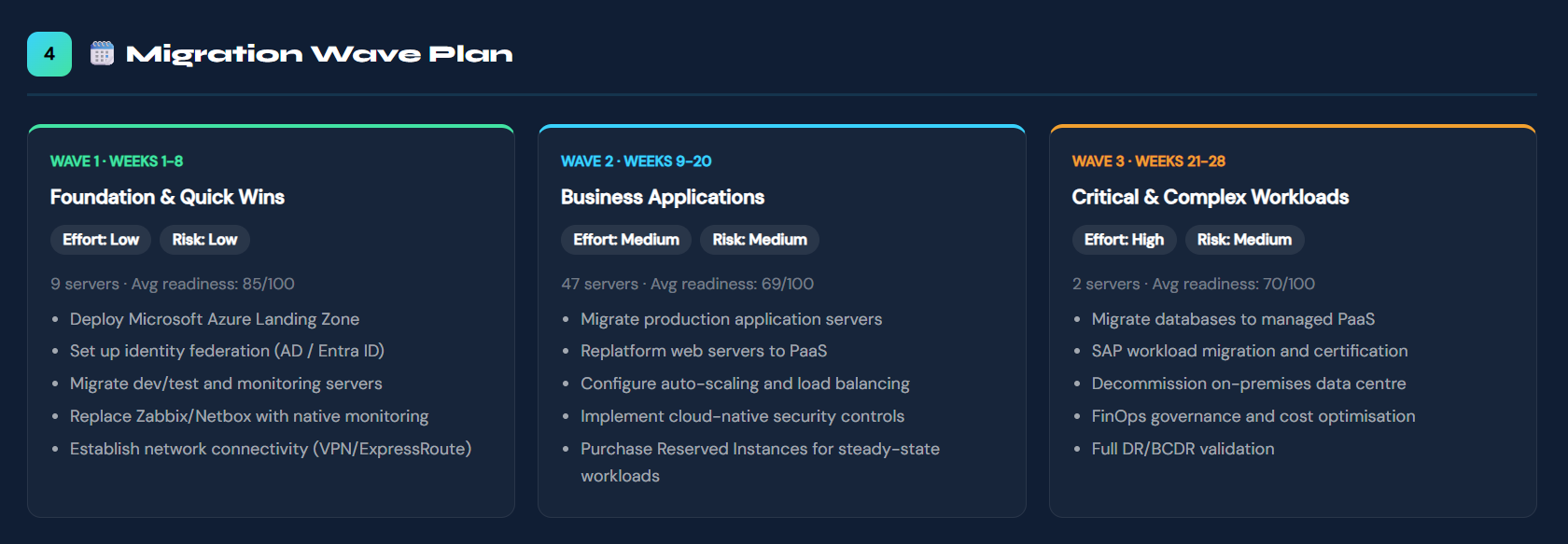
Migration Wave Plan — 3-wave migration over 28 weeks. Wave 1: Foundation & Quick Wins (dev/test, monitoring). Wave 2: Business Applications (production servers). Wave 3: Critical & Complex Workloads (SAP, databases).
🎯
Per-Server Readiness Score
Every server gets a readiness score, migration strategy and blocker list
🗓️
3-Wave Migration Plan
Automated wave assignment based on complexity, criticality and dependencies
👥
Skills Gap Assessment
Identifies cloud certification needs before migration starts
🔗
Dependency Analysis
Maps identity, network, storage and monitoring dependencies
What is a Cloud Migration Readiness Assessment?
A migration readiness assessment evaluates how prepared your infrastructure is for cloud migration — before you start. It scores each server on OS version, workload type, hosting environment and dependencies, then assigns it to the right migration wave with a recommended strategy (rehost, replatform or replace).
TCOIQ's readiness assessment covers the full migration lifecycle: server readiness scoring, 3-wave migration planning, skills gap identification (AZ-305, AWS SAA, GCP-ACE certifications), dependency mapping (Active Directory, network, shared storage) and risk register.
Industry benchmark: 60-70% of servers in a typical hybrid environment are cloud-ready with low effort (rehost/lift-and-shift). 20-25% require replatforming to managed PaaS services. 5-10% are complex workloads (SAP, large databases) requiring specialist planning.
Common Migration Readiness Use Cases
On-premises cloud readiness assessment
Azure migration readiness
AWS migration assessment
GCP migration readiness score
Data centre exit planning
Cloud migration wave planning
VMware migration assessment
Cloud skills gap analysis
Server dependency mapping
SAP cloud readiness
Security & Compliance Assessment
Identify security gaps before cloud migration. Maps your controls to ISO 27001, SOC 2, MAS TRM, GDPR and NIST CSF — with a 90-day remediation roadmap.
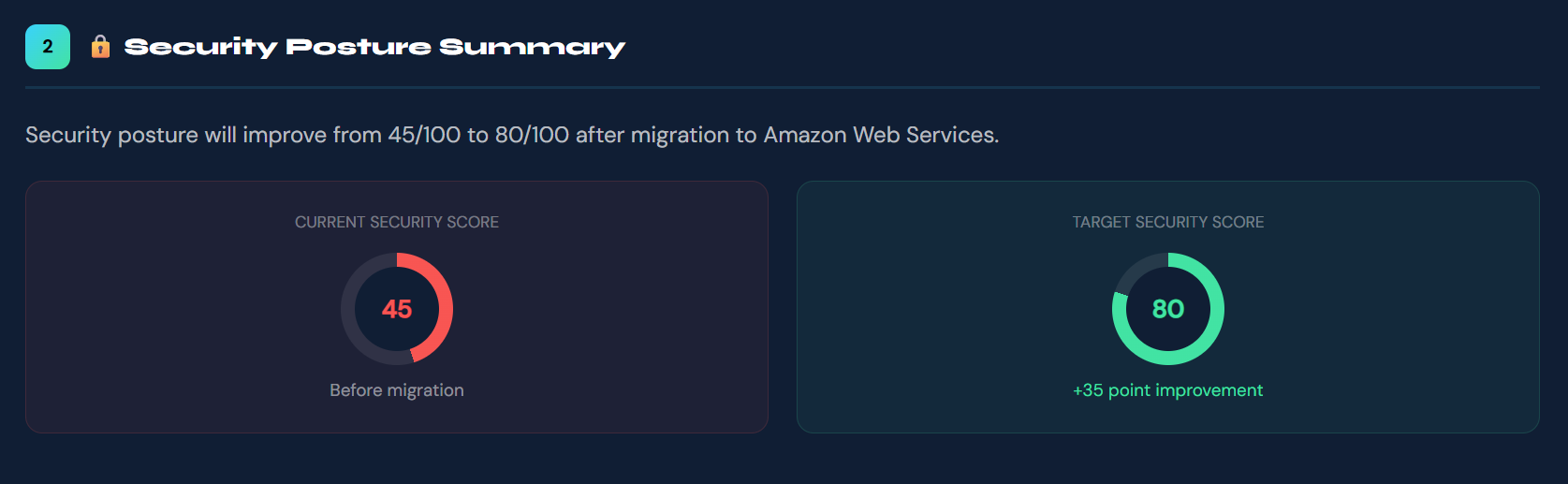
Security Posture Summary — Current security score vs target score after migration. Shows improvement in points and number of critical gaps identified.
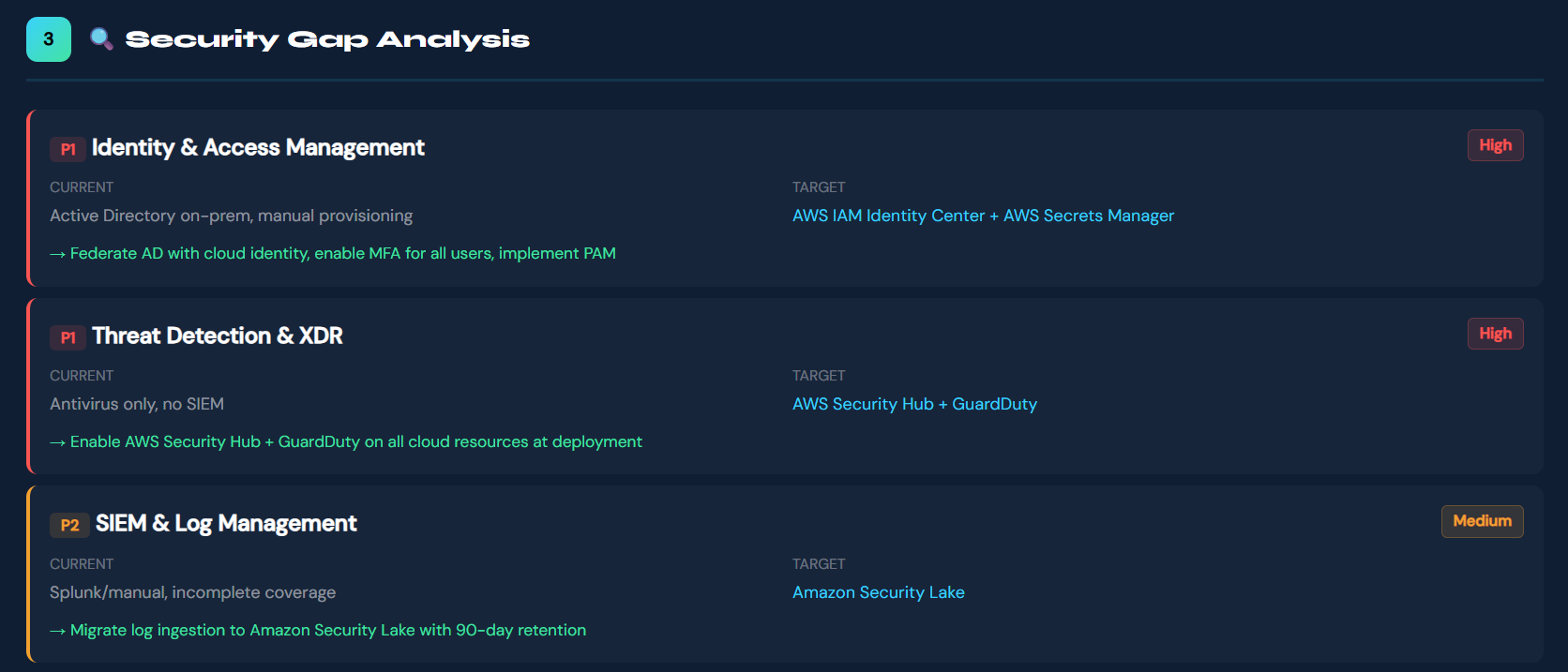
Security Gap Analysis — 10 domains: Identity, XDR, SIEM, Encryption, Network, WAF, DDoS, Vulnerability Management, Backup & DR, Compliance. Each shows current state, target service and remediation action.
🛡️
10 Security Domains
Identity, encryption, network, XDR, SIEM, WAF, DDoS, backup, vulnerability and compliance
📋
5 Compliance Frameworks
ISO 27001, SOC 2 Type II, MAS TRM, GDPR and NIST CSF gap analysis
🗓️
90-Day Remediation Plan
Phase 1 critical controls, Phase 2 identity & network, Phase 3 compliance & monitoring
🏗️
Target Security Architecture
Cloud-specific security services mapped to your target cloud (AWS/Azure/GCP/OCI)
What is a Cloud Security Assessment?
A cloud security assessment identifies gaps between your current security posture and the controls required for secure cloud operation. It evaluates identity management, encryption, network segmentation, threat detection, compliance frameworks and disaster recovery — mapping each gap to a specific cloud-native security service.
TCOIQ assesses compliance against ISO 27001 (114 controls), SOC 2 Type II (64 trust service criteria), MAS TRM (Singapore financial sector), GDPR (EU data protection) and NIST CSF — producing a gap scorecard and 90-day remediation roadmap with P1/P2/P3 prioritisation.
Critical finding in most on-premises environments: no MFA on admin accounts, no cloud-native XDR/CSPM, unencrypted storage volumes, and flat network architecture. These 4 controls account for 80% of cloud breach risk and can be remediated in Phase 1 (Weeks 1-4) before migration begins.
Common Security Assessment Use Cases
On-premises security assessment
Cloud security gap analysis
ISO 27001 cloud compliance
SOC 2 cloud assessment
MAS TRM compliance assessment
GDPR cloud migration
Azure security assessment
AWS security compliance
Zero trust network assessment
Cloud CSPM assessment
Financial sector cloud security
Healthcare cloud compliance
Cloud Cost Optimisation Report
Already on cloud? Upload your billing export and find Reserved Instance savings, rightsizing opportunities and idle resources. Typical result: 30-60% savings identified.
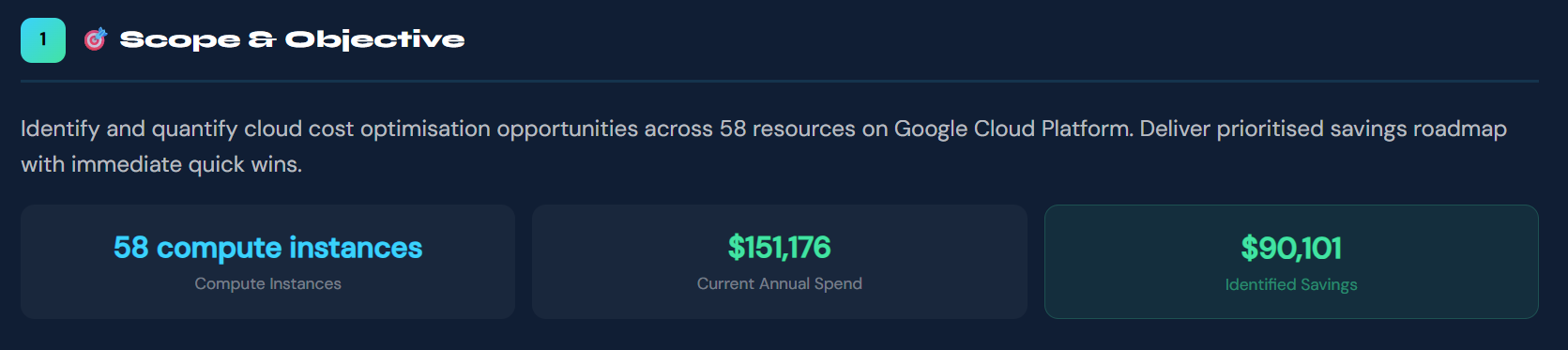
Scope & Objective — Current annual cloud spend, compute instances analysed and total identified savings.
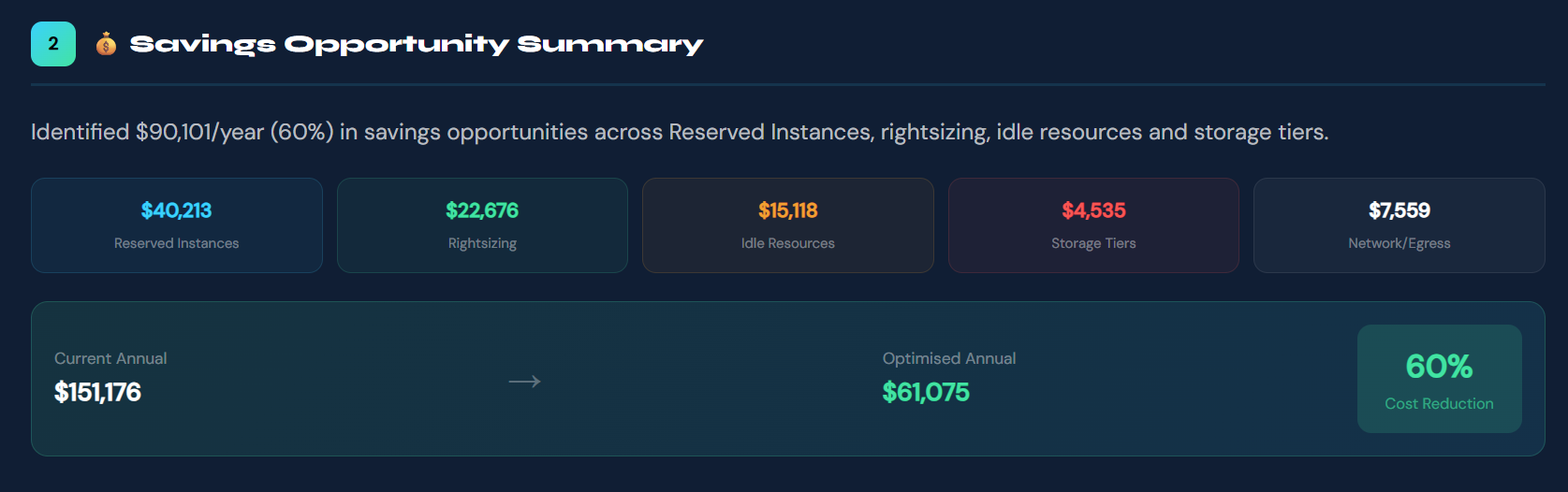
Savings Opportunity Summary — Breakdown: Reserved Instances, rightsizing, idle resources, storage tiers and network/egress. Shows optimised annual spend and % cost reduction.
🎫
Reserved Instance Analysis
1-year and 3-year RI savings vs on-demand for all steady-state workloads
📐
Rightsizing Recommendations
Per-server rightsizing based on CPU/RAM utilisation data (30% headroom)
🗑️
Idle Resource Cleanup
Identifies stopped instances, unattached volumes and orphaned resources
📊
FinOps Governance
Cost allocation tags, budget alerts and monthly review cadence recommendations
What is Cloud Cost Optimisation?
Cloud cost optimisation is the process of reducing cloud spending without reducing performance or capability. Most organisations overspend on cloud by 30-45% due to over-provisioned instances, on-demand pricing for steady-state workloads, idle resources and unoptimised storage tiers.
TCOIQ analyses your cloud billing export (AWS Cost Explorer, Azure Cost Analysis, GCP billing, OCI cost reports) and identifies savings across 5 categories: Reserved Instances (save 28-50%), rightsizing (save 20-30%), idle resource cleanup (save 8-15%), storage tier optimisation (save 15-70%) and network/egress reduction (save 5-15%).
FinOps best practice: implement cost allocation tags, set budget alerts at 80% and 100% of target, establish a monthly FinOps review cadence, and use cloud-native tools (AWS Compute Optimizer, Azure Advisor, GCP Recommender) for continuous rightsizing. TCOIQ's report includes a full FinOps governance roadmap.
Common Cost Optimisation Use Cases
AWS cost optimisation
Azure cost reduction
GCP cost savings
OCI cost analysis
Cloud rightsizing tool
Reserved Instance planning
Cloud waste reduction
FinOps implementation
Cloud billing analysis
AWS Cost Explorer analysis
Azure cost management
Cloud spend optimisation
Free — No Credit Card Required
Run Your Assessment in 60 Seconds
Upload your server inventory or cloud billing export. Get a full AI-powered report instantly — TCO analysis, migration readiness, security compliance or cost optimisation.
Supports: Excel .xlsx · CSV · Azure Migrate · RVTools · AWS Cost Explorer · GCP Billing · OCI Cost Report
Frequently Asked Questions
What does a cloud TCO analysis report include?
A TCOIQ cloud TCO report includes an executive summary with 3-year savings, current environment analysis, target cloud cost model with Reserved Instance pricing, 5-cloud comparison across AWS, Azure, GCP, OCI and Alibaba, plus migration roadmap, target architecture and risk register.
Can TCOIQ compare on-premises to cloud costs?
Yes — this is TCOIQ's primary use case. Upload your server inventory (RVTools export, Azure Migrate, manual Excel) and get a full on-premises to cloud TCO comparison across all 5 major clouds in 60 seconds.
What file formats are supported?
Excel (.xlsx), CSV, JSON, PDF. Auto-detects Azure Cost Analysis, AWS Cost Explorer (date-column and pivot formats), GCP billing exports, OCI cost reports, RVTools exports and manual server inventories.
How accurate are the cloud pricing figures?
Prices are based on 2026 published cloud provider rates including Reserved Instance discounts (AWS 1yr: 28%, 3yr: 42%; Azure 1yr: 30%, 3yr: 42%; GCP CUD 1yr: 25%, 3yr: 38%; OCI 1yr: 35%, 3yr: 50%). Always verify final pricing with the cloud provider before procurement.
Is TCOIQ free to use?
Free plan: run any assessment, see cover page and executive summary. Pro plan ($5/month): full report with all sections, PDF download, 5-cloud comparison and unlimited assessments.